

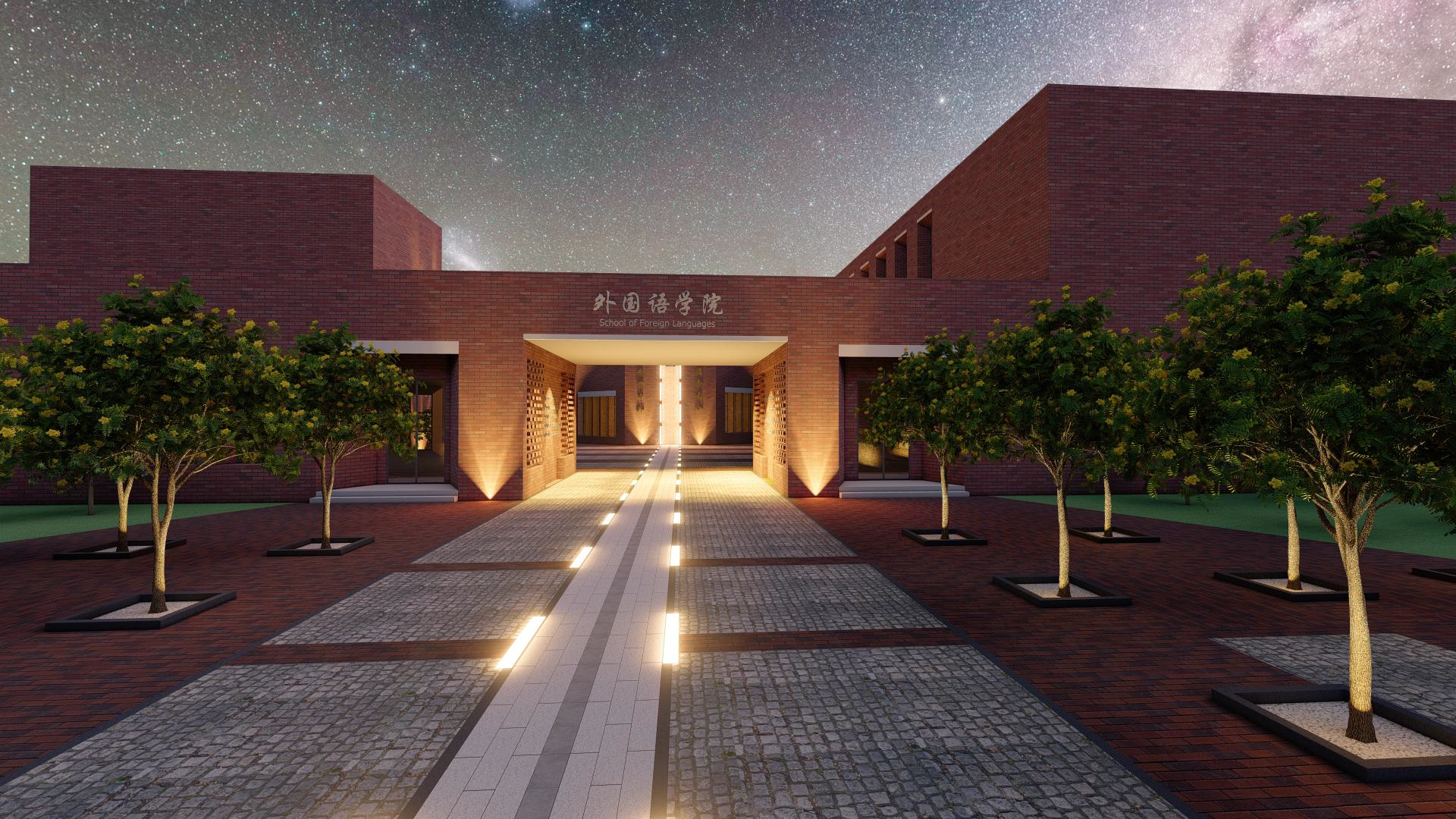


Department of English
School of Foreign Languages, Tianjin University
Updated July 12, 2026
Founded in 1981, the English Program at Tianjin University was among the first English programs established at China’s key science and engineering universities. Originally developed from the University’s English for Science and Technology tradition, the program has built a distinctive interdisciplinary profile by drawing on Tianjin University’s strengths in engineering and its rich humanistic heritage. In 2022, it was recognized as a National First-Class Undergraduate Program.
In response to national strategic needs in the new era, the program has developed an “English+” talent-training framework that takes English education as its core and integrates it with artificial intelligence, law, cybersecurity, and other disciplines. Beginning in 2026, the School of Foreign Languages jointly offers three Double Bachelor’s Degree Programs—English + Artificial Intelligence, English + Law, and English + Cybersecurity—while also offering an English major with a specialization in Area Studies. Together, these form a structure of “three double-degree programs plus one specialization.” All four pathways are grounded in strong English language proficiency, intercultural communication, and international understanding, and aim to cultivate interdisciplinary graduates with a global outlook, digital literacy, rule awareness, and the ability to work across disciplinary boundaries.
The Department of English has 13 full-time faculty members, including 9 professors and associate professors and 10 faculty members with doctoral degrees. All faculty members have overseas study or visiting experience. Their expertise covers sociolinguistics, experimental phonetics, second language acquisition and language intelligence, English literature, intercultural and area studies, translation, international communication, and language services for international and professional contexts. This broad expertise enables the Department to provide students with interdisciplinary learning opportunities and research guidance.
The program is supported by the doctoral program in Area Studies, the Institute for Global South Studies, and the National First-Class Undergraduate Program platform. It works closely with the School of Artificial Intelligence, the School of Law, and the School of Cyber Science and Technology to co-develop curricula, courses, and practical training platforms. Faculty members also lead or participate in a range of national and provincial-level research and educational reform projects.
The English Program follows the principles of “strong foundations, deep interdisciplinarity, practice orientation, and internationalization.” While maintaining English language competence as the foundation, it places particular emphasis on interdisciplinary integration.
Supported by the doctoral program in Area Studies and the Institute for Global South Studies, this specialization builds a curriculum around “language competence – regional knowledge – research methods – international communication.” Featured courses include Introduction to Area Studies, International Relations and Global Governance, Reading Regional Policy Documents, and Language Situation Monitoring and Data Analysis. Through case studies, textual analysis, and fieldwork, students develop the ability to use English for country and regional studies, international communication, and foreign-related affairs.
Jointly developed by the School of Foreign Languages and the School of Artificial Intelligence, this program is anchored in English education while integrating courses such as Introduction to Artificial Intelligence, Machine Learning, Natural Language Processing, and Multilingual Speech and Language Intelligence Processing. Through language data analysis, intelligent product evaluation, and project-based practice, students develop both language-and-culture expertise and the ability to apply AI technologies, together with strong competence in international technical communication.
Jointly developed by the School of Foreign Languages and the School of Law, this program centers on advanced English proficiency and intercultural communication while incorporating legal foundations, international rules, and foreign-related legal practice. Featured courses include Legal English, International Law, International Economic Law, Reading International Treaties and Contracts, and Foreign-Related Legal Writing. Through bilingual case discussions and simulated negotiations, students develop legal reasoning and a solid understanding of international rules for professional work in foreign-related contexts.
Jointly developed by the School of Foreign Languages and the School of Cyber Science and Technology, this program is anchored in English education and highlights the integration of “language × technology × rules.” Students study cybersecurity, data security, international rules, cross-border data compliance, and the reading and translation of security-related documents. Through incident reporting, case analysis, and international collaboration exercises, students learn to understand technology, interpret rules, and communicate positions effectively.
The program is supported by language laboratories, simultaneous interpreting laboratories, computer-assisted translation platforms, and stable on- and off-campus practice bases, providing strong support for student research training and innovation.
The program actively expands international learning opportunities by drawing on the faculty’s extensive overseas experience and international academic networks. It collaborates with overseas universities and scholars in co-taught courses, academic lectures, joint research, short-term exchanges, and student study programs. Students are also encouraged to participate in international conferences, international competitions, overseas summer schools, and exchange programs so that they can strengthen their academic communication, professional communication, and global competence in authentic intercultural settings.
The three Double Bachelor’s Degree Programs and the Area Studies specialization also continue to develop international cooperation resources tailored to their respective training goals in artificial intelligence, foreign-related rule of law, cybersecurity, and area studies, providing students with multi-level and interdisciplinary international opportunities.
Guided by Tianjin University’s motto, “Seeking Truth from Facts,” the English Program is committed to fostering virtue through education. Oriented toward national strategic needs and grounded in strong language training, it features interdisciplinary integration and aims to cultivate high-level interdisciplinary graduates with firm ideals and convictions, a strong sense of responsibility to the country, a broad international outlook, solid English proficiency, and outstanding interdisciplinary competence.
Graduates are expected first to acquire strong English language skills, intercultural understanding and communication competence, and the ability to use English to access information, analyze problems, and articulate China’s perspectives. On this foundation, they develop systematic knowledge and methods in artificial intelligence, law, cybersecurity, or area studies, together with digital literacy, rule awareness, innovation capacity, global competence, and lifelong learning ability. These strengths prepare them to contribute in areas such as international organizations, foreign-related legal affairs, international communication, AI and digital industries, international cyberspace governance, education, and research.
The first-attempt pass rate for the Test for English Majors Band 4 (TEM-4) has consistently remained above 95%.
The program has established 15 stable practical teaching bases and 2 nationally recognized internship bases for graduate education in professional translation degree programs, and it collaborates with a number of leading enterprises in industry–university education.
In recent years, approximately 55% of graduates have continued their studies at well-known universities in China and abroad. Other graduates have primarily entered Party and government institutions, centrally administered state-owned enterprises, educational and research institutions, technology companies, and multinational corporations.
At the undergraduate level, the School offers the English major with an Area Studies specialization and three Double Bachelor’s Degree Programs jointly developed with relevant schools: English + Artificial Intelligence, English + Law, and English + Cybersecurity. All four pathways are anchored in English as the primary discipline and emphasize interdisciplinary integration.
At the master’s level, the School admits students to programs including Foreign Linguistics and Applied Linguistics and the Master of Translation and Interpreting (MTI).
At the doctoral level, advanced training is provided through the doctoral program in Area Studies, forming an integrated pathway from undergraduate to master’s and doctoral education.
Head of Department: Hui Feng
Party Branch Secretary: Dan Zhou
Deputy Head of Department: Anqi Yang
School website: https://tjusfl.tju.edu.cn/wgyxy.htm
Official WeChat Account: School of Foreign Languages, Tianjin University
下一条:Chen Dazhong
Address:Yaguan Road 135, Haihe Education Park, Jinnan District, Tianjin, China.
Post Code:300350 Email:sfll@tju.edu.cn
Copyright @copy 2015 School of Foreign Languages,Tianjin University.All Rights reserved.